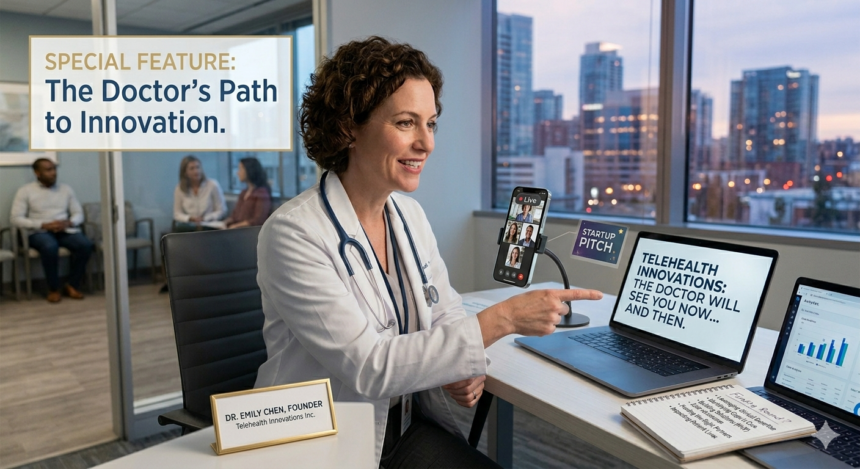
Last October, Hong Kong’s Chinese University Faculty of Medicine dropped a quiet bombshell on traditional medical education. With the 2026–27 academic year, it will roll out “CU Medicine Plus,” a six-year curriculum explicitly designed to produce physicians who are also innovators, leaders, entrepreneurs, and humanitarians. Students will still master anatomy and diagnostics, but they will also tinker with AI, run humanitarian projects, and explore minors in engineering or public health. No more pure clinicians shuffling between wards and textbooks. The message is clear: the doctor of tomorrow will see you in clinic—and then head to the boardroom or the incubator.
I first sensed this shift not in a press release but in a late-night Zoom with a final-year medical student from Lahore. She had just finished a 36-hour call and was sketching an app to triage rural patients using cheap smartphone cameras. “Sir,” she said, half-joking, “I’m training to save lives, but half my brain is already building the company that might make my own job obsolete.” Her exhaustion was real; so was her excitement. That conversation stuck with me because it captured the tension at the heart of the new trend: medical schools are no longer content to graduate technicians. They want multi-hyphenate physicians—clinicians who can also code, lead, fundraise, and fix broken systems. The question is whether this is visionary or reckless.
Healthcare is choking on its own success. Global ageing populations, chronic-disease epidemics, and AI-driven diagnostics have turned medicine into a trillion-dollar innovation race. Traditional training—long on rote memorisation, short on systems thinking—leaves graduates ill-equipped to redesign delivery models or commercialise breakthroughs. A 2017 landscape review found only 8.2 percent of US allopathic schools offered formal innovation and entrepreneurship (I&E) tracks; today the number hovers around 15 percent and is climbing fast. Programs at Michigan, Florida, and Stanford’s Biodesign fellowship are churning out graduates who file patents, raise venture capital, and launch companies before residency is over. CU Medicine Plus simply formalises what forward-thinking faculties already sense: the pure clinician is becoming an endangered species.
Critics, of course, are sharpening their scalpels. “We already lose too many hours to burnout,” one senior clinician told me during grand rounds last month. “Now you want them pitching startups between rounds?” The fear is legitimate. Medical school is brutal enough without adding business-plan workshops. Core clinical skills—bedside manner, pattern recognition under pressure, ethical judgment—still separate good doctors from great ones. A 2023 analysis warned that diverting time from patient contact risks producing “technically savvy but clinically shallow” graduates. In Pakistan and much of the Global South, where doctor-patient ratios remain dire, any dilution of hands-on training feels like luxury we cannot afford.
Yet the data tells a different story. Physicians who become entrepreneurs do not abandon medicine; they supercharge it. Look at Hinge Health’s co-founders or the physician-led teams behind Tempus and Ro—startups that have slashed costs, expanded access, and delivered measurable clinical outcomes. A 2025 study of I&E program participants showed participants were 54 percent more likely to win research awards, 31 percent more likely to publish, and significantly better at teamwork and communication. Graduates of Northwestern’s program founded Briteseed; USC’s produced StemSurgical. These are not distractions. They are force multipliers. The same analytical mind that spots a missed diagnosis also spots a market gap. Medical training, it turns out, is the ultimate entrepreneurship boot camp: observe, hypothesise, test, iterate—only the stakes are human lives.
CU Medicine Plus gets the balance right by weaving innovation into the spiral curriculum rather than bolting it on. In the first two years—MedExplore—students do community service and pick up minors in computer science or engineering. Years three and four—MedExceed—let them chase research projects in specialties that intrigue them. Only in the final stretch—MedExcel—do they embed in real-world clinical attachments while honing leadership. Dean Philip Chiu Wai-yan put it plainly: “We emphasise going beyond traditional classroom learning by integrating innovative technologies with medical knowledge.” No study suspensions, no forced timelines. Flexibility is baked in so clinical excellence remains non-negotiable.
Compare that to older models still dominant in South Asia. In Pakistan, the PMDC curriculum remains heavily lecture-based with minimal exposure to health-tech or policy. Young doctors graduate fluent in textbooks but bewildered by procurement tenders, regulatory hurdles, or how to pitch a low-cost ventilator to a cash-strapped hospital. The result? Brain drain. Talent flees to Dubai or the US where innovation ecosystems reward the multi-hyphenate. Hong Kong’s experiment, by contrast, aligns medical education with national policy—positioning the city as an “international hub for life and health innovation.” The lesson is geopolitical as much as pedagogical: nations that train physicians to invent will own the next century of healthcare IP.
Of course, implementation matters. Not every student wants to be an entrepreneur. CU Medicine Plus wisely makes tracks elective within a core clinical spine. Faculty must include hybrid mentors—clinicians with MBAs, engineers who understand HIPAA. Funding cannot come at the expense of ward teaching; governments and philanthropies must step up. And ethics cannot be an afterthought. When a student’s startup competes with hospital procurement, conflicts of interest must be transparent. The goal is not to turn every doctor into a venture capitalist but to give every doctor the toolkit to question the status quo.
The payoff, however, is immense. Healthcare costs are projected to consume 20 percent of global GDP by 2030 in many economies. Without physician-led innovation, we will simply manage decline. With it, we can bend the cost curve, close equity gaps, and harness AI without losing the human touch. The multi-hyphenate physician is not a luxury; she is the insurance policy against a future where medicine becomes commoditised and impersonal.
So what should medical schools do? First, audit every curriculum for “innovation hours” the way we audit clinical hours. Second, create seed funds that pair students with industry mentors without forcing equity giveaways. Third, measure success not just by board scores but by prototypes built, policies influenced, and communities served. Pakistan’s medical colleges could start small—pilot tracks in final year, partner with local tech hubs in Karachi and Lahore. The talent is already here; the scaffolding is missing.
A student remarked, “I don’t want to stop being a doctor. I just want to stop being powerless when the system fails my patient.” That sentence should be the mission statement of every dean. The stethoscope and the startup pitch are not rivals. They are two sides of the same oath: first, do no harm—and then, wherever possible, do vastly more good.
The era of the pure clinician is ending not because compassion is obsolete, but because compassion without ingenuity is insufficient. Medical schools that cling to the old model will produce competent doctors for yesterday’s problems. Those that embrace the multi-hyphenate future will produce the leaders who solve tomorrow’s. The choice is no longer academic. It is existential.