Beyond the Literacy Numbers: Pakistan’s Education Emergency
Last month, while navigating the bustling streets of Mingowra, I overheard a rickshaw driver lamenting to his passenger about his daughter’s future. “She goes to school, but what does she learn? Nothing that puts food on the table,” he sighed. This casual exchange captured a painful truth far beyond official literacy figures. Pakistan’s education system is in a state of emergency—not just because millions are out of school, but because even those inside classrooms are emerging unprepared for life in the 21st century.
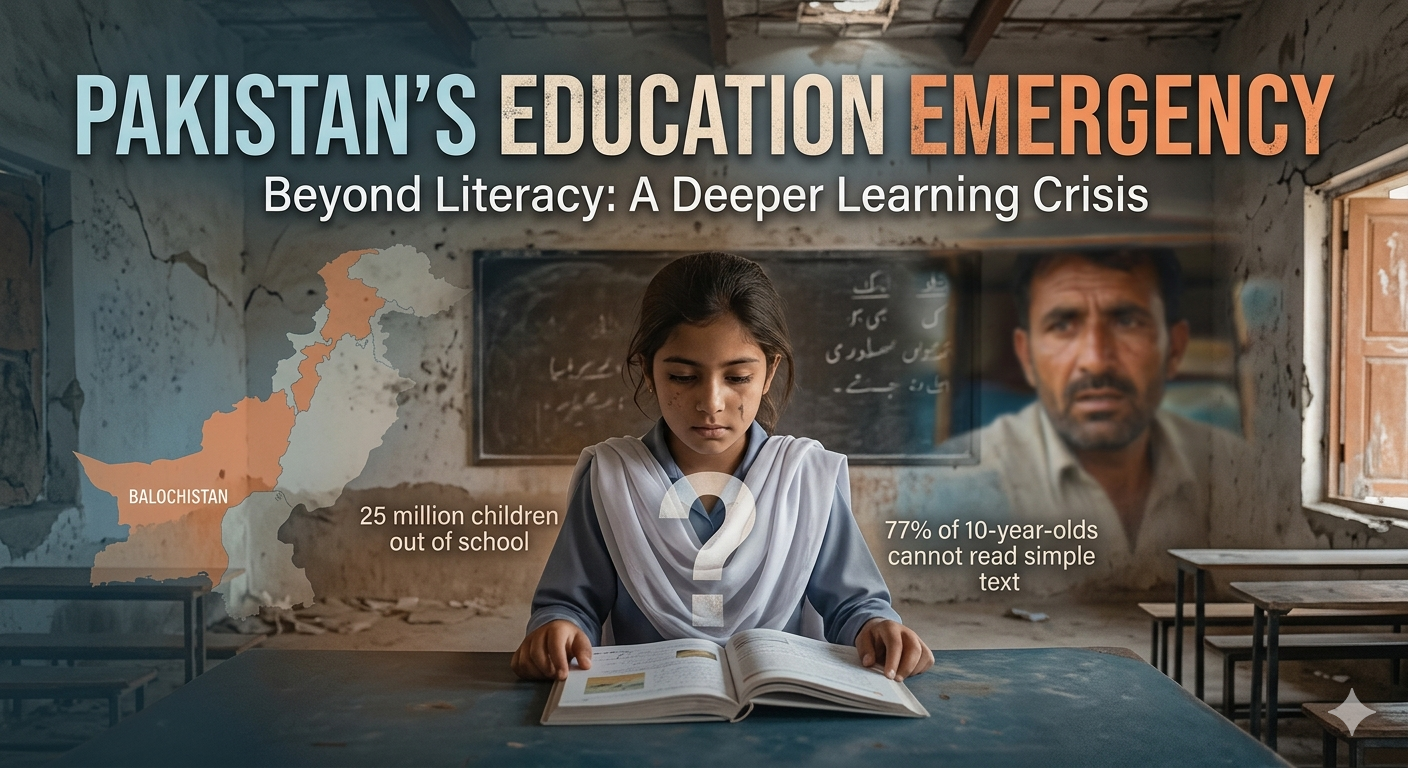
The numbers tell a stark story. With roughly 25-26 million children aged 5-16 out of school—second only to one other nation globally—Pakistan faces an enrollment crisis of epic proportions. Balochistan bears the heaviest burden proportionally, with nearly 69% of school-age children excluded, while Punjab holds the largest absolute number. Yet the deeper failure lies in learning outcomes. A recent government report reveals that 77% of ten-year-olds cannot read or understand a simple text. This “learning poverty” condemns an entire generation to diminished prospects.
Enrollment alone is a hollow victory. Many children who do attend school grapple with overcrowded classrooms, undertrained teachers, and curricula that prioritize rote memorization over critical thinking or skills. Provincial disparities exacerbate the issue: dropout rates climb sharply after primary levels, particularly for girls in rural areas, where poverty, cultural norms, and safety concerns collide. Gender gaps persist, with girls from low-income households far less likely to complete even basic education.
Public investment compounds the emergency. Education spending has plummeted to around 0.8-1.7% of GDP in recent years, well below the UNESCO-recommended 4-6%. This chronic underfunding starves infrastructure, teacher training, and foundational programs like early childhood education. As one analyst noted in discussions around the Prime Minister’s 2024 declaration of a National Education Emergency, policy announcements have come repeatedly—May and September 2024—yet implementation lags, and budgets continue to shrink.
I recall visiting a government school in a peri-urban area near Odigram a couple of years ago. The building was crumbling, textbooks were shared among five students, and the teacher, though dedicated, confessed she lacked training in modern pedagogy. The children were bright-eyed and eager, but their potential was being squandered by a system designed for a different era. That visit underscored how the crisis is not abstract; it plays out in dusty classrooms and stunted ambitions across the country.
This is not merely a social issue—it is an economic time bomb and a geopolitical vulnerability. A poorly educated workforce hampers productivity, innovation, and competitiveness in a region where neighbors like India and Bangladesh have made strides in human capital. Pakistan’s youth bulge, often touted as a demographic dividend, risks becoming a liability of unemployment, social unrest, and migration pressures if unaddressed. Long-term consequences include slower GDP growth, higher poverty traps, and weakened national resilience.
Comparisons are instructive. Countries that invested aggressively in education quality alongside access have reaped dividends in stability and growth. Pakistan, by contrast, risks falling further behind in South Asia and the broader Muslim world, where educated populations drive progress.
The emergency demands more than declarations. Sustained political will must translate into action: increasing spending to at least 4% of GDP with transparent accountability; prioritizing teacher training and performance incentives; expanding targeted stipends and safe transport for girls; and embracing technology and public-private partnerships for scale. Community involvement, as in successful local models, and a focus on foundational literacy and numeracy in the early years are non-negotiable.
Pakistan’s leaders, from Islamabad to the provinces, must treat this as a national security imperative. The children sitting in—or absent from—classrooms today will shape the economy, governance, and society of 2047 and beyond. Investing in them is not charity; it is the surest path to sovereignty and prosperity. The time for half-measures is over. An education emergency requires emergency-level commitment—now.
One email a week. No noise.
A single story unwound carefully, plus the few things worth your time. Free, and it stays that way.