Pakistan's First National Conference on “Connected for Care’’ Strengthening capacities on GBV case Management in Pakistan
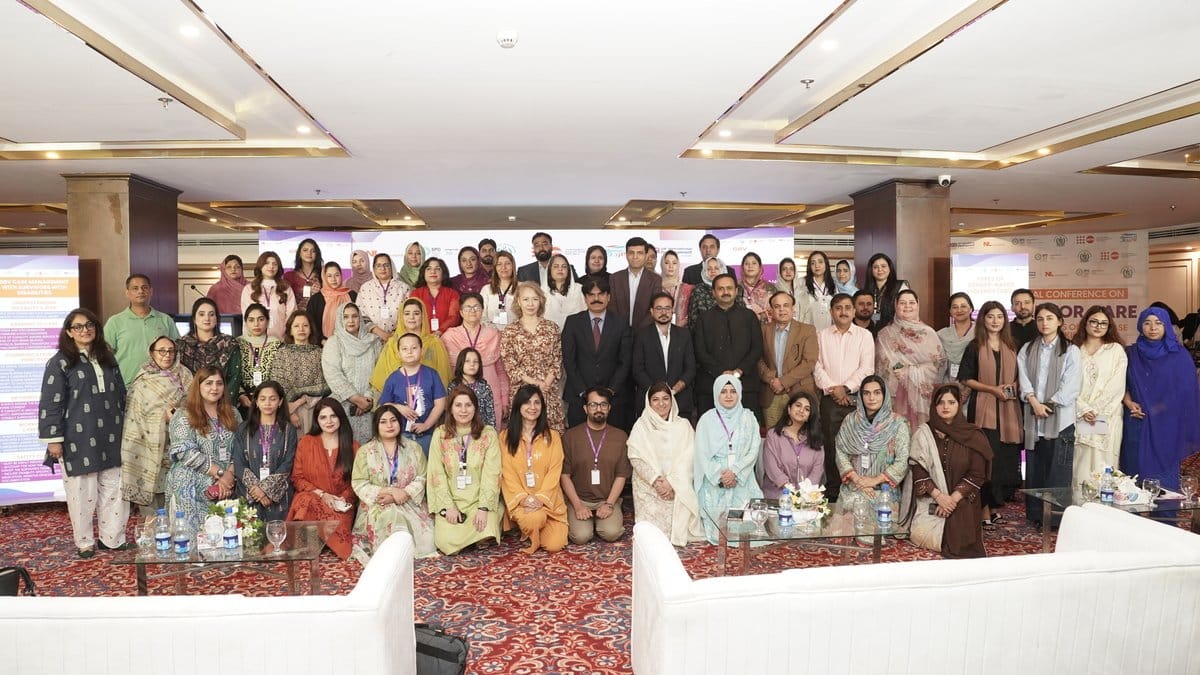
Certified Gender-Based Violence (GBV) Case Management Trainers from Punjab, Sindh, Khyber Pakhtunkhwa, Balochistan, and the Islamabad Capital Territory (ICT) convened in Islamabad on 22nd June, 2026 for the Two-Day National Conference; “Connected for Care’’. Convened by the Ministry of Human Rights with technical support from UNFPA Pakistan and Strengthening Participatory Organization (SPO) and with the generous financial support of the Foreign, Commonwealth and Development Office (FCDO) and the Embassy of the Netherlands in Pakistan, the first-ever national gathering of Certified GBV Case Management Trainers marks a landmark moment to strengthen coordinated, ethical, and survivor-centered GBV response across Pakistan.
Read More: Pakistan’s Doctor Exodus: KP’s Healthcare on Life Support
The opening ceremony commenced with the National Anthem and recitation, followed by a presentation tracing the journey of the GBV Case Management capacity-building initiative in Pakistan from the early response to COVID-19 in 2020 to the multi-province, multi-cohort initiative that has today produced a national pool of certified practitioners till 2026. High-level remarks were delivered by representatives of the UNFPA Pakistan, SPO, and the Ministry of Human Rights, underscoring the sustained political, technical, and financial investment that has made this conference possible.
In his welcome remarks, Mr. Arif Laghari, Director (IC), Ministry of Human Rights, highlighted that gender-based violence remains a deeply entrenched and persistent issue in society, with women continuing to face various forms of violence, including sexual and domestic violence. He stressed that significant systemic challenges persist in ensuring accountability, reflected in low conviction rates, noting that data from 2023 indicates approximately 10,000 cases were disposed of at the pre-trial stage before formal framing of charges, pointing to critical gaps in investigation and case processing. He further emphasised that MoHR, with support from UNFPA and SPO remains committed to ensuring that the capacity built through including GBV case management in HEC and medical colleges’ curriculum so that it can be translated into lasting, measurable improvements in the quality of care that survivors receive at the community level.
Dr. Gulnara Kadyrkulova, Deputy Representative, UNFPA Pakistan, highlighted that nearly one in three ever-married women in Pakistan has experienced physical, sexual, or emotional violence, yet more than half of survivors never seek help, reflecting deep social, cultural, and institutional barriers to safe, quality care. She stressed that GBV case management, as a structured survivor-centered approach, is central to breaking down these barriers by ensuring survivors are informed of their options, their needs are addressed in a coordinated way, and they receive consistent support throughout their journey. She further added that this conference marks a new chapter in that journey, moving from individual training cohorts towards a connected and sustained practice. “This is what Connected for Care truly means,” she said, “ensuring that the survivors we serve are supported by a system that is connected across provinces, across institutions, and across the public and development sectors.”
In her opening remarks, Dr. Farhat Sheikh, Board Member, SPO, stressed that building survivor confidence through sensitivity, confidentiality, and a survivor-centered approach remains the cornerstone of effective GBV case management, noting that mishandling of cases and fear of confidentiality breaches are among the primary reasons survivors do not come forward. She highlighted the growing threat of technology-based gender-based violence as an area requiring urgent capacity development and underscored that a coordinated, multi-sectoral approach spanning health, legal, social protection, and civil society is essential to achieving meaningful outcomes for survivors.
A defining feature of the conference was a series of provincial poster presentations in which Tier 1 and Tier 2 certified trainers from all five regions took centre stage. Trainers from Punjab, Sindh, Khyber Pakhtunkhwa, Balochistan, and ICT presented their provinces’ work in GBV case management,, showcasing service delivery models, field realities, promising practices, and the challenges encountered in applying case management principles across vastly different social, institutional, and geographic contexts. The presentations generated animated cross-provincial dialogue, with participants identifying shared barriers including limited referral coordination, social stigma, inadequate supervisory structures, and the absence of GBV services in many districts, as well as context-specific strategies that have shown success in improving survivor outcomes.
One email a week. No noise.
A single story unwound carefully, plus the few things worth your time. Free, and it stays that way.