

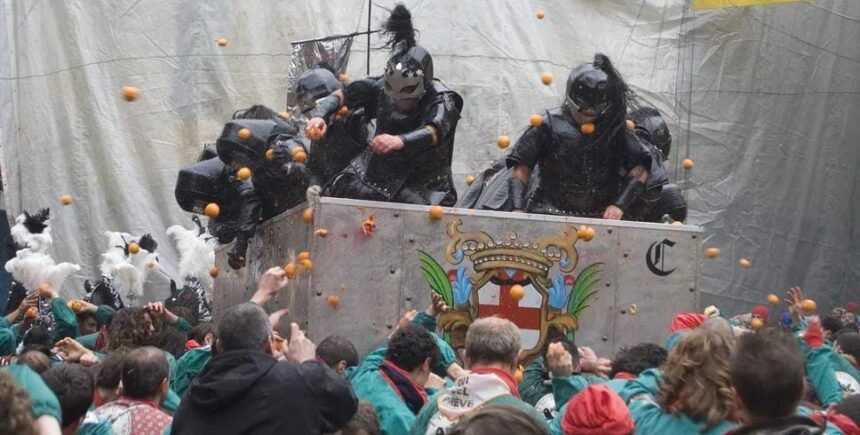
The town of Ivrea once again turned into a battlefield of flying fruit as the famous Battle of the Oranges reached its peak from February 15 to 17, 2026. The event is the main highlight of the Historic Carnival of Ivrea and is known as one of Italy’s most unusual festivals.
The carnival season began earlier on January 6, 2026. However, the real excitement came during three straight days, Sunday, Monday, and Tuesday, when thousands of people took part in the orange fight. The festival officially ended on Wednesday, February 18, with the traditional distribution of polenta and cod to the public.
The Battle of the Oranges, or “Battaglia delle Arance,” is not just a fun event. It is based on a historic story from the 12th century. According to legend, a brave young woman named Violetta, the daughter of a miller, stood up against a cruel baron and killed him. The battle represents the people’s revolt against tyranny. The oranges symbolize either the tyrant’s head or the stones thrown during the uprising.
During the event, nine teams of orange throwers, known as aranceri, fight on foot. They throw oranges at more than 50 horse-drawn carriages. The people on the carriages represent the tyrant’s army.
For safety, spectators must wear a red Phrygian cap, also called the Berretto Frigio. This cap shows that they are not part of the fight and should not be hit. Protective nets are also placed in the main squares, including Piazza di Città, Piazza Ottinetti, and Piazza del Rondolino.
Each year, around 600 tons of oranges are used. These oranges are not suitable for eating. After the festival, they are collected and turned into organic fertilizer, making the event more environmentally friendly.
The Battle of the Oranges remains one of Italy’s most exciting and historic celebrations.