

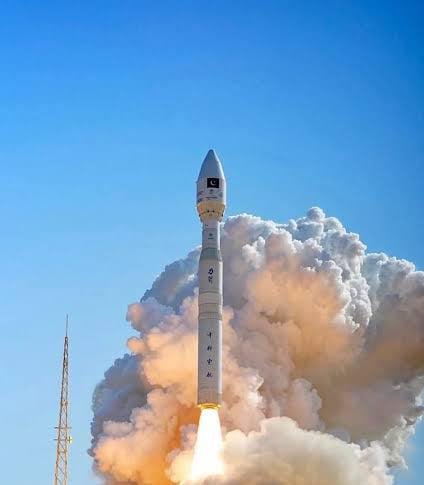
Pakistan has achieved another milestone in space technology with the successful launch of its second Earth observation satellite, PRSC-EO2. The satellite was sent into space on February 12 through a Chinese rocket, marking an important step in the country’s growing space program.
The satellite was launched at 14:37 Beijing time aboard the Smart Dragon-3 (SD-3) commercial carrier rocket. In a historic first for Pakistan, the launch took place from the sea. The rocket lifted off from a mobile platform in the waters near Yangjiang, Guangdong Province, China. After launch, the satellite was successfully placed into its planned orbit.
PRSC-EO2, which stands for Pakistan Remote Sensing Satellite Earth Observation 2, has been developed to collect valuable data from space. It will help in climate monitoring, urban planning, disaster management, and gathering important images of the Earth. Officials say the satellite will support national development projects and improve planning in many sectors.
Prime Minister Shehbaz Sharif congratulated the nation and praised the scientists and engineers who worked on the project. He said the satellite would play a key role in collecting critical data for the country. Deputy Prime Minister and Foreign Minister Ishaq Dar also welcomed the achievement. He stated that the launch reflects Pakistan’s steady progress in space technology and self-reliance.
On February 15, SUPARCO announced another important development: the launch of Pak-SBAS, a Satellite-Based Augmentation System. This system will provide more accurate navigation and location services. It works by monitoring and using signals from China’s BeiDou Navigation Satellite System.
Officials thanked China for its strong cooperation and support in space projects. They said the partnership between the two countries continues to grow, especially in advanced technology.
The successful launch of PRSC-EO2 shows Pakistan’s increasing technical skills and determination to move forward in space research. It is seen as a major step toward a stronger and more independent national space program.