

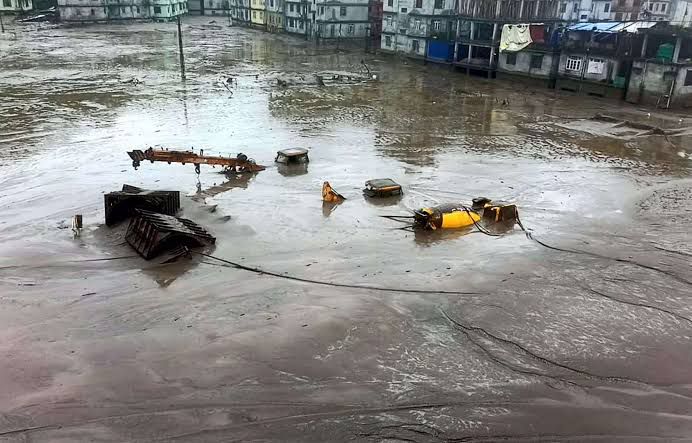
Tragedy struck the mountainous region of Sikkim in northeast India this week when a Himalayan lake flooded, causing widespread devastation. At least 40 lives were lost, and many more are still unaccounted for, making it one of the worst disasters the region has witnessed in half a century. Ironically, scientists and government authorities were in the midst of developing an early warning system for glacial floods at the very lake when disaster struck. The system, which included a camera to monitor Lhonak Lake’s water levels and weather instruments, had recently been installed, offering the potential to provide critical evacuation warnings. However, as we delve into the details of this missed opportunity, it becomes evident that even the best-laid plans sometimes fall victim to unforeseeable circumstances.
The initiative to create an early warning system for Lhonak Lake’s glacial floods has remained largely unreported until now. As geoscientist Simon Allen from the University of Zurich, who was involved in the project, expressed, “It’s quite absurd, really. The fact it happened just two weeks after our team was there was terrible luck.”
The initial phase of the system, consisting of a camera to monitor the lake’s water levels and weather monitoring instruments, had been implemented just last month. The potential of this system, if fully operational, was to offer residents valuable time for evacuation in the event of an impending flood, a critical measure for the region’s safety.
One of the key components planned for future integration was a tripwire sensor. This sensor would have been designed to activate if the lake’s water level indicated an imminent burst. Such a sensor would have been linked to an alert system, ensuring that residents received timely warnings to evacuate to higher ground.
However, the timeline for the full system’s implementation faced a hurdle. The Indian government had not approved the complete system for deployment this year, thus necessitating a two-step process for its development.
Despite the initial preparations, the monitoring devices encountered an unexpected setback when the camera lost power in late September. The cause of this power loss remains undisclosed, as reported by a source at the Swiss embassy, which had provided support for the project.
The tragic incident at Lhonak Lake sheds light on the increasing risks posed by glacial lake outburst floods (GLOFs) in high mountain regions. As climate change accelerates the melting of glaciers, these lakes become susceptible to overfilling and bursting, unleashing torrents of water down mountain valleys. Research from 2022 has identified over 200 such high-hazard lakes in the Himalayan region, affecting communities in India, Pakistan, China, Nepal, and Bhutan.
In recent years, early warning systems for glacial floods have been implemented in neighboring countries like China, Nepal, Pakistan, and Bhutan to address this growing threat. The proposed early warning systems at Lhonak Lake and the nearby Shako Cho in Sikkim were intended to be among the first of their kind in India, aiming to mitigate the risk of glacial lake outburst floods.
Experts have long warned of the potential for outburst floods from these two lakes, but bureaucratic processes and funding challenges have delayed progress. Kamal Kishore, a senior official at India’s National Disaster Management Authority (NDMA), mentioned that India has plans to install early warning systems at several other glacial lakes but did not provide further details about the Lhonak project.
Read more: Tragedy Strikes as Glacial Lake Burst in India Claims 40 Lives
Nevertheless, Farooq Azam, a glaciologist at the Indian Institute of Technology Indore, pointed out that even with an early warning system in place, the benefits might not always be straightforward. He emphasized that events like these unfold rapidly, potentially offering only a few minutes or, at best, an hour of advance notice.
The tragic flooding at Lhonak Lake serves as a sobering reminder of the delicate balance between human efforts to safeguard against natural disasters and the unpredictable forces of nature. While the potential benefits of an early warning system were evident, the untimely power loss in the monitoring camera underscores the challenges in mitigating the risks posed by glacial lake outburst floods in the Himalayan region.