

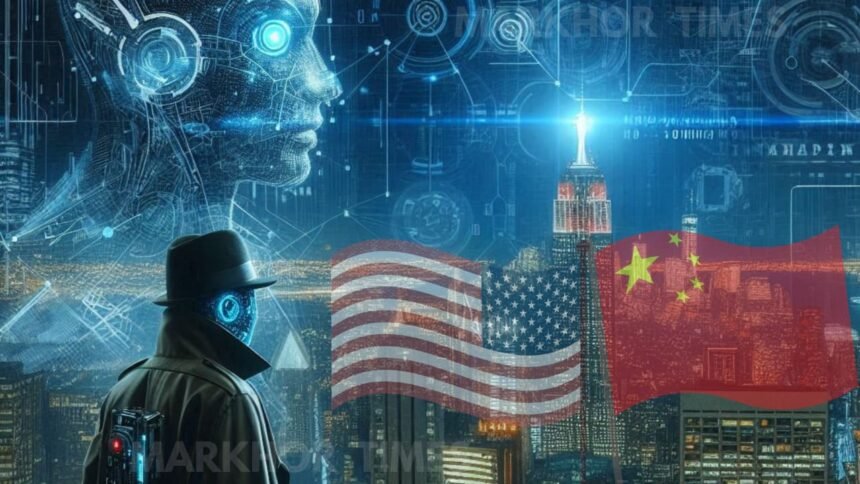
The global race for power is no longer about weapons, it’s about technology. In today’s world, the United States and China are locked in a high-stakes competition to lead the future of Artificial Intelligence (AI). This modern rivalry is shaping industries, economies, and even global influence, as both nations invest billions into cutting-edge innovation.
During the 20th century, the US and the Soviet Union competed to build nuclear weapons. Today, that race has shifted toward AI, where the goal is not destruction but dominance in technology. From research labs to universities and fast-growing startups, this competition is unfolding everywhere, backed by governments and tech giants.
Experts often describe this battle as a clash between “brains” and “bodies.” The United States has traditionally led in AI “brains,” meaning advanced software, microchips, and large language models like ChatGPT and similar systems. On the other hand, China has built a strong reputation in AI “bodies,” especially in robotics and manufacturing.
In early 2025, China made headlines by launching its own AI chatbot called DeepSeek. It quickly gained attention because it offered features similar to Western AI tools but at a much lower cost. This development shocked global markets, even affecting major tech companies like Nvidia, which saw a historic drop in market value shortly after the announcement.
China’s strength lies in hardware. Over the past decade, the government has heavily invested in robotics, funding research and providing massive subsidies to manufacturers. Today, China is home to nearly two million working robots, more than the rest of the world combined. These machines are widely used in factories and industries, performing repetitive tasks efficiently.
However, building a robot is only half the challenge. Every machine needs a “brain” software that tells it what to do. Simple robots can handle repetitive tasks, but more advanced robots require intelligent systems powered by agent-based AI. This is where the United States still holds an advantage, thanks to its leadership in advanced chips and AI software.
According to experts, nearly 80% of a robot’s value comes from its “brain.” This includes the software and processing power that enable machines to think, adapt, and perform complex actions. Companies like Boston Dynamics are already pushing boundaries with robots like Spot, a dog-like machine equipped with advanced sensors and smart capabilities.
At the same time, China continues to innovate in robotics. In April 2025, Beijing hosted the world’s first humanoid half-marathon, where robots competed in a long-distance race. One standout, Tiangong Ultra, completed the race in just under three hours, highlighting China’s rapid progress in robotic engineering.
As both nations push forward, the AI race is becoming more intense and unpredictable. The future may depend on which country can successfully combine powerful “brains” with advanced “bodies.” One thing is clear: this competition will shape the next era of technology and the world as we know it.