

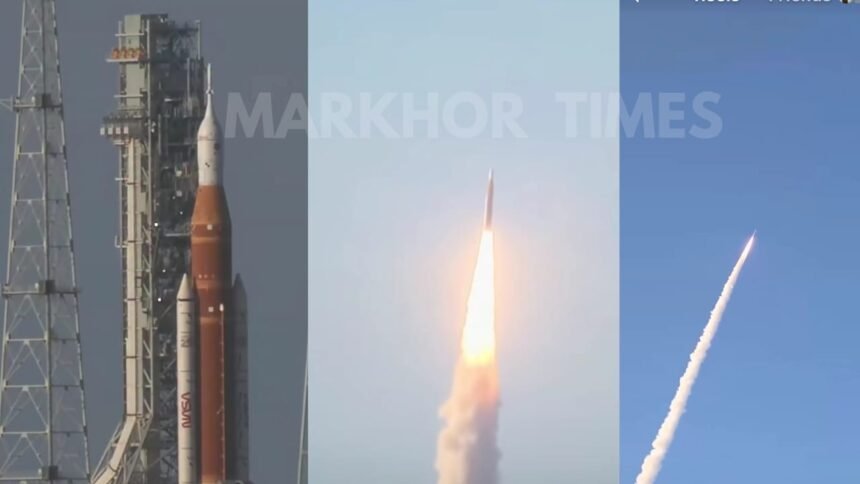
NASA has successfully launched the Artemis II mission, sending astronauts on a historic journey around the Moon. The mission lifted off on April 1, 2026, aboard the powerful Space Launch System (SLS) rocket from Kennedy Space Center in Florida. This mission is a major step toward returning humans to the lunar surface and beginning a new era of deep space exploration.
The Artemis II mission carries four astronauts: Commander Reid Wiseman, Pilot Victor Glover, Mission Specialist Christina Koch, and Canadian astronaut Jeremy Hansen from the Canadian Space Agency. This diverse crew is making history, as it includes the first woman, first person of color, and first non-American astronaut to travel beyond low Earth orbit toward the Moon.
Shortly after launch, the Orion spacecraft, named Integrity, successfully deployed its solar array wings a crucial step for the mission. These solar panels are attached to the European Service Module and stretch up to 63 feet wide when fully opened. Each wing contains around 15,000 solar cells that convert sunlight into electricity, ensuring a steady power supply throughout the mission. The arrays can rotate to follow the Sun, allowing maximum energy generation as the spacecraft travels through space.
The mission is expected to last approximately 10 days. During this time, Orion will travel thousands of miles beyond the Moon and then return safely to Earth. Key maneuvers, including orbit adjustments such as perigee raise and apogee raise burns, will prepare the spacecraft for deep-space conditions and ensure a smooth journey.
Artemis II is not just a test flight it is a foundation for future missions. The spacecraft was built by Lockheed Martin, while the service module was developed by Airbus. Together, they represent some of the most advanced space technologies ever created.
NASA plans to use Artemis II as a stepping stone for future lunar missions, including landing humans on the Moon again by 2028. This will be the first time humans return to the Moon since the Apollo missions, particularly the historic flights like Apollo 8.
As the Artemis program continues, this mission brings humanity closer to long-term space exploration, including future missions to Mars.