Submit

You can submit your opinions to MT

Covering Domestic and Global affairs

Markhor Times
Search
  • National
  • Sports
  • Government
  • World
  • Entertainment
  • Editorial
Reading: Celestial Spectacle: Moon and Mars Create a Captivating Display for Skywatchers Tonight
Share
Font ResizerAa
Markhor TimesMarkhor Times
Search
Follow US
Made by ThemeRuby using the Foxiz theme. Powered by WordPress
Homepage Blog Technology Celestial Spectacle: Moon and Mars Create a Captivating Display for Skywatchers Tonight
Technology

Celestial Spectacle: Moon and Mars Create a Captivating Display for Skywatchers Tonight

By
Zarghona Jannat
Last updated: May 23, 2023
2 Min Read
Share
Moon and Mars
Moon and Mars

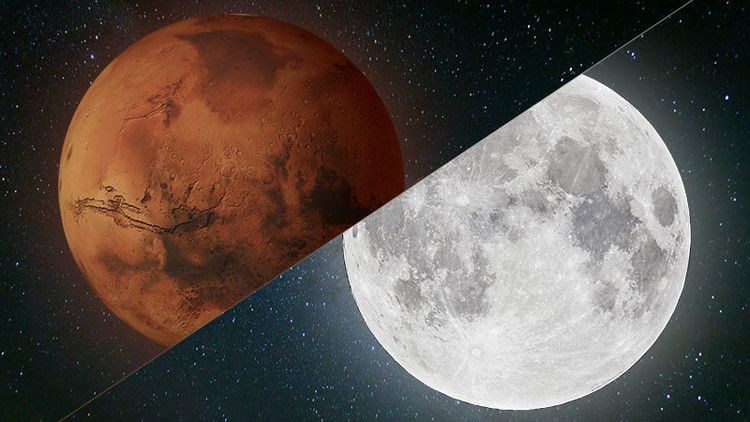
Skywatchers are in for a treat as the moon and Mars engage in a captivating celestial dance over the next two nights. On Wednesday (May 24), the moon and Mars will have their closest approach, known as an appulse, and conjunction, where they share the same right ascension. This means that observers will witness the two celestial bodies in close proximity in the night sky.

Although the precise moment of appulse is at 3:19 p.m. EDT (1919 GMT), and the exact moment of conjunction is at 1:33 p.m. EDT (1733 GMT) on Wednesday, according to In the Sky, the best viewing opportunities for the moon and Mars will be during the night. Specifically, the optimal time to observe this cosmic spectacle is either tonight or Wednesday night, preferably before midnight or 1 a.m., depending on your location.

During the appulse and conjunction, the moon will be in its waxing crescent phase, five days old. Mars will be situated just 3 degrees and 39 minutes away from the moon at their closest approach, making it possible to observe both objects simultaneously through binoculars. (For reference, a clenched fist held at arm’s length covers approximately 10 degrees of the sky.)

Although the moon and Mars may appear close to each other from Earth’s perspective, they are actually around 180 million miles (290 million kilometers) apart.

To locate the moon and Mars in the night sky, direct your gaze toward the constellation Cancer, although spotting Earth’s neighboring planet should be relatively straightforward even without assistance.

TAGGED:Space ScienceTechnology adoption
Share This Article
Facebook Email Copy Link Print
Leave a Comment Leave a Comment

Leave a Reply Cancel reply

Your email address will not be published. Required fields are marked *

YOU MAY ALSO LIKE

Pakistan’s Largest IT Festival ITCN Asia 2026 Concludes with Anticipated US$ 750 Million Economic Impact

Pakistan’s Largest IT Festival ITCN Asia 2026 Concludes with Anticipated US$ 750 Million Economic Impact

Technology
January 19, 2026

BingX Becomes Scuderia Ferrari HP’s First-Ever Crypto Exchange Partner

BingX Becomes Scuderia Ferrari HP's First-Ever Crypto Exchange Partner

Technology
January 16, 2026

ITCN Asia 2026, Supported by SIFC and STZA, Set to Spotlight Pakistan’s Digital and Startup Ecosystem

ITCN Asia 2026, Supported by SIFC and STZA, Set to Spotlight Pakistan’s Digital and Startup Ecosystem

Technology
January 14, 2026

ISRO Launches Heaviest Satellite from Indian Soil

The BlueBird satellite weighs about 6,100 kilograms, which is more than six tons. This makes it the heaviest payload ever…

Technology
January 3, 2026
Markhor Times is an independent, privately owned publication focusing on Domestic and Global Affairs and bringing truth forward in this fast paced, biased world of media. MT is one of the emerging e-outlets in Pakistan, headquartered in Pakistan.

Follow US: 

Markhor Times Advertising (SMC-PRIVATE) Limited

Email: ameer@markhortimes.com
Tel: +92-3348881455

Welcome Back!

Sign in to your account

Username or Email Address
Password

Lost your password?