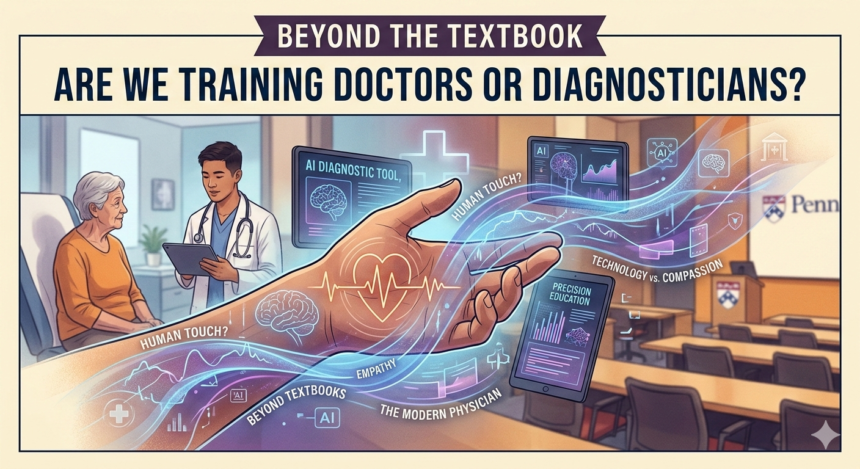
I remember sitting in a bustling clinic in Mingora last year, watching a young resident fumble through a patient consultation. The elderly man complained of chest pain, but the resident’s eyes kept darting to his tablet, cross-referencing symptoms with an AI diagnostic tool. The interaction felt mechanical—efficient, yes, but missing that subtle empathy that turns a diagnosis into true care. It struck me then: as medical education hurtles toward a tech-driven future, are we equipping future physicians with gadgets at the expense of genuine human connection? This question feels urgent now, with institutions like Penn Medicine rolling out AI-powered “precision education” programs amid a global push for immersive training tools.
The integration of advanced technologies into medical curricula isn’t just a trend; it’s a revolution reshaping how we prepare the next generation of doctors. From Artificial Intelligence (AI) tutors providing personalized feedback to Virtual Reality (VR) simulations of surgical procedures, these tools promise to create immersive, risk-free environments that traditional textbooks could never match. But as we embrace this “tech-ified” curriculum, a critical balance hangs in the air: between technological proficiency and the irreplaceable “human touch” that defines bedside manner. In regions like Pakistan, where healthcare disparities amplify the need for compassionate care, this shift could either bridge gaps or widen them, depending on how we navigate it.
At the heart of this transformation is the drive for precision and efficiency. Take Penn Medicine’s Clinical Reasoning Insights for Shaping Performance (CRISP) initiative, funded by a $1.1 million American Medical Association grant in early 2026. This program uses AI to analyze electronic health records and ambient listening data, delivering tailored coaching to medical students and residents. Instead of a one-size-fits-all approach, learners get competency-based progression, accelerating their clinical skills in a data-driven way. It’s part of a broader movement toward “precision education,” where AI aggregates performance data to customize training, much like how it personalizes patient care. Globally, similar efforts are underway. In low- and middle-income countries (LMICs), where access to advanced training is limited, Augmented Reality (AR) and VR are bridging geographical divides, allowing students to practice complex procedures virtually during pandemics or resource shortages.
These innovations offer undeniable benefits. VR and AR enable experiential learning in safe settings, honing skills like hand-eye coordination and spatial awareness without risking patient lives. Studies show that medical students using VR complete procedures 20% faster and with 38% more accuracy than those trained traditionally. Wearable biosensors add another layer, monitoring physiological responses in real-time during simulations, providing immediate feedback on stress management or decision-making under pressure. For overstretched systems in places like Khyber Pakhtunkhwa, where doctor-to-patient ratios are alarmingly low, this could mean more competent graduates entering the workforce sooner. AI tools also predict learner needs, identifying at-risk students early and intervening with adaptive tutorials—potentially reducing dropout rates in rigorous programs.
Yet, this tech-centric focus raises red flags about the erosion of core humanistic skills. Bedside manner—the art of listening, empathizing, and building trust—has long been the soul of medicine. But as screens and simulations dominate training, there’s a risk of producing “diagnosticians” who excel at algorithms but falter in human interactions. A recent panel at Penn AI highlighted concerns over AI’s potential to foster overreliance, bias, and a dilution of clinical reasoning. In my own experience mentoring interns in Pakistan, I’ve seen how excessive gadget use can create a barrier: a resident once missed a patient’s emotional cues about family stress because he was too focused on inputting data into an app. Research echoes this; while tech enhances efficiency, it can disrupt workflows if not integrated thoughtfully, leading to increased workload and less face-to-face time. In chronic disease management, where patient empowerment is key, over-emphasizing tech might sideline the motivational conversations that encourage adherence.
Comparisons across regions underscore these tensions. In the U.S., where Penn Medicine leads with AI scribes that handle note-taking, freeing doctors for more patient interaction, adoption is seamless thanks to robust infrastructure. Contrast this with LMICs, where unreliable internet or limited device access could exacerbate inequalities, turning tech into a luxury rather than a tool. A 2025 review of AR/VR in healthcare noted growth during COVID-19, but warned of accessibility gaps in resource-poor settings. Critiques of leadership in medical education point to a flaw: curricula often prioritize measurable tech competencies over intangible soft skills, potentially producing physicians who are technically adept but emotionally detached.
The immediate consequences are clear—patients in tech-heavy environments report better understanding when digital tools blend with human guidance, but satisfaction dips if interactions feel impersonal. Long-term, we risk a healthcare workforce ill-equipped for the nuances of cultural contexts, like in Pakistan where family dynamics heavily influence treatment decisions. As one AMA expert noted, AI should “boost personalization” without replacing learner agency. Without balance, we might see rising burnout from tech overload or ethical lapses from biased algorithms.
To move forward, stakeholders must act decisively. Medical schools should mandate hybrid curricula that pair AI simulations with mandatory empathy training, perhaps using VR for “webside manner” practice in telemedicine scenarios. Policymakers in countries like Pakistan could invest in affordable biosensors and AI platforms, ensuring equitable access while incorporating cultural sensitivity modules. Institutions like Penn Medicine set a model by combining AI with ethical guidelines, but global collaborations—such as AMA-style grants for LMICs—could amplify this. Ultimately, educators must foster a vision where technology amplifies humanity, not supplants it. By doing so, we can train doctors who diagnose with precision and heal with compassion, turning the “tech-ified” curriculum into a force for holistic care.