

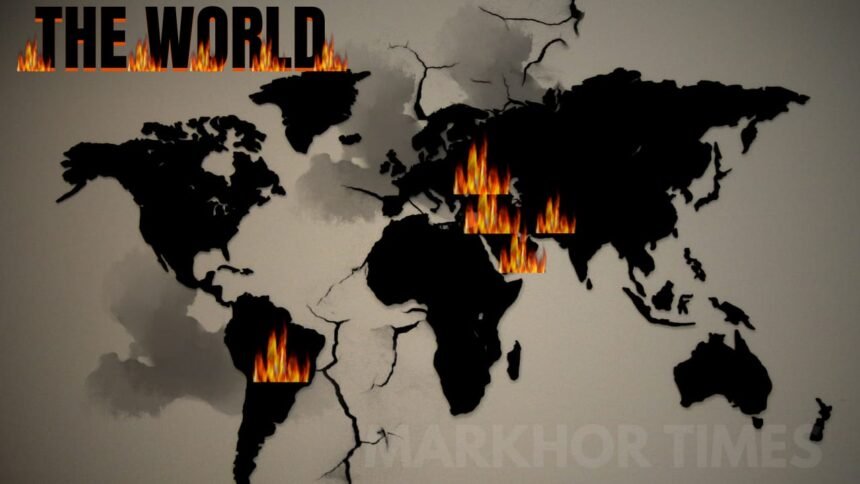
Today, conflicts are no longer limited to one region. From the Middle East to Eastern Europe, Africa, and parts of Asia, many countries are facing war, unrest, or armed tensions. Analysts estimate that more than 50 to 90 countries are currently affected by organized violence in some form. Because of this global situation, believers are reflecting deeply on prophetic teachings about the final times and the responsibilities of the Muslim Ummah.
A World Surrounded by Conflict
Several regions are witnessing ongoing crises. The Middle East remains tense with conflicts involving Israel, Palestine, Iran, Syria, Yemen, and other neighboring states. Fighting continues in Eastern Europe between Russia and Ukraine, while instability affects Afghanistan and Pakistan in South Asia. Parts of Africa, including Sudan, Nigeria, Somalia, and the Sahel region, are also struggling with violence and civil wars. These widespread conflicts have created fear that the world may be entering a period of major upheaval.
Many Muslims connect these events with descriptions found in Ahadith about a great global conflict known as Al-Mulhimah al-Kubra, often described as a massive war before the Day of Judgment. Islamic narrations describe a time when alliances will form, battles will intensify, and humanity will face immense loss and suffering.
Prophetic Warnings About Chaos
The Prophet Muhammad (peace be upon him) warned about a time when confusion and violence would spread widely. In one well-known narration, he said that a period would come when “the killer would not know why he killed, and the victim would not know why he was killed.” Many believers see similarities between this description and modern warfare, where civilians often suffer and conflicts become complex and unclear.
Another Hadith explains that nations would unite against the Muslim Ummah like people gathering around a dish of food. Scholars historically interpreted this as a period of weakness among Muslims, not only politically but also spiritually. For many scholars, the message is not fear, but self-reflection and renewal of faith.
Signs Leading Toward the Final Events
Islamic tradition mentions several major signs expected before the Day of Judgment. Among them is the appearance of Imam Mahdi, who is believed to restore justice and unity among Muslims during a time of great trials. Later, the emergence of Dajjal is described as the greatest test for humanity, followed by the return of Prophet Isa (Jesus), peace be upon him, who will defeat falsehood and establish justice.
Other signs mentioned in authentic narrations include the spread of wealth alongside dissatisfaction, widespread trials entering every home, and temporary peace agreements followed by betrayal and large-scale war involving many nations.
While some people try to match current events directly with these prophecies, scholars caution against declaring any specific war as the final one. The exact timing of the Hour remains known only to Allah.
The Responsibility of the Last Ummah
Islam teaches that Muslims are part of the Last Ummah, the final community before the Day of Judgment. Rather than focusing only on fear or predictions, Islamic teachings emphasize repentance, unity, patience, and returning to Allah during times of hardship.
Many scholars remind believers that global crises should inspire moral reform. Strengthening faith, helping those in need, maintaining justice, and avoiding division are seen as essential duties during troubled times.
A Call for Reflection
The current global atmosphere has created anxiety and uncertainty, but Islamic teachings offer guidance rooted in hope and responsibility. Wars and disasters are viewed not only as political events but also as reminders of life’s temporary nature.
Whether these events are among the final signs or simply another chapter in human history, one message remains clear in Islam: believers should turn back to Allah, increase good deeds, and work for peace and justice.
As the world faces growing instability, many Muslims see this moment as a time not for panic, but for spiritual awakening a reminder that preparation for the Hereafter begins with sincere faith and righteous action today.