

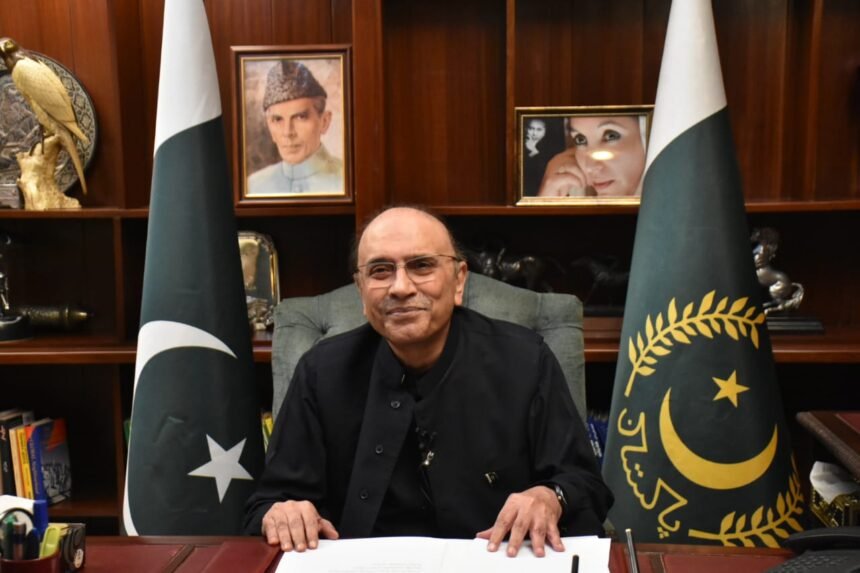
President Asif Ali Zardari delivered a strong and wide-ranging address to a joint session of parliament, outlining Pakistan’s security priorities, foreign policy direction, and political roadmap for the new parliamentary year. In his ninth presidential address, he made it clear that Pakistan would not allow any domestic or foreign group to use neighboring territory to disturb peace inside the country.
The session began amid loud protests from opposition members, who raised slogans throughout the proceedings in support of their jailed leadership and against the government. Despite the tense atmosphere and chants near the podium, President Zardari continued his speech calmly and presented the government’s vision for the coming year.
A major focus of the address was national security and rising tensions along Pakistan’s western border. The president stated that Pakistan had exhausted diplomatic efforts before responding to cross-border terrorist incidents originating from Afghan territory. He emphasized that under Article 51 of the United Nations Charter, Pakistan holds the right to defend its sovereignty and territorial integrity.
According to the president, recent actions by Pakistan’s armed forces demonstrated restraint but also sent a clear message regarding the country’s defensive capabilities. He said the entire nation stands united with the armed forces and law enforcement agencies in combating terrorism and protecting national borders.
President Zardari also referred to intelligence-based operations carried out over the past three years against militant networks allegedly supported through proxy warfare. He stressed that Pakistan’s tolerance for attacks linked to groups such as the Tehreek-e-Taliban Pakistan (TTP) and the Balochistan Liberation Army (BLA) had reached its limit.
Quoting findings from a recent United Nations Security Council monitoring report, the president warned that terrorist organizations operating from Afghan soil pose a wider regional threat. He said ignoring the issue could lead to catastrophic consequences for other countries as well.
Despite security concerns, Zardari emphasized that Pakistan continues to view the Afghan people as brothers and remains committed to dialogue and peaceful cooperation. He urged Afghan authorities to prevent their territory from being used by militant groups and called for a future built on stability and economic progress rather than conflict.
Highlighting recent military responses along both eastern and western borders, the president praised Pakistan’s security forces for acting with professionalism and discipline. He expressed gratitude to soldiers and officers for defending the nation during challenging times.
Concluding his address, President Zardari called for national unity, political stability, and continued cooperation among institutions to strengthen Pakistan internally while promoting peace across the region. He said lasting security can only be achieved through collective resolve, responsible diplomacy, and unwavering commitment to national sovereignty.