

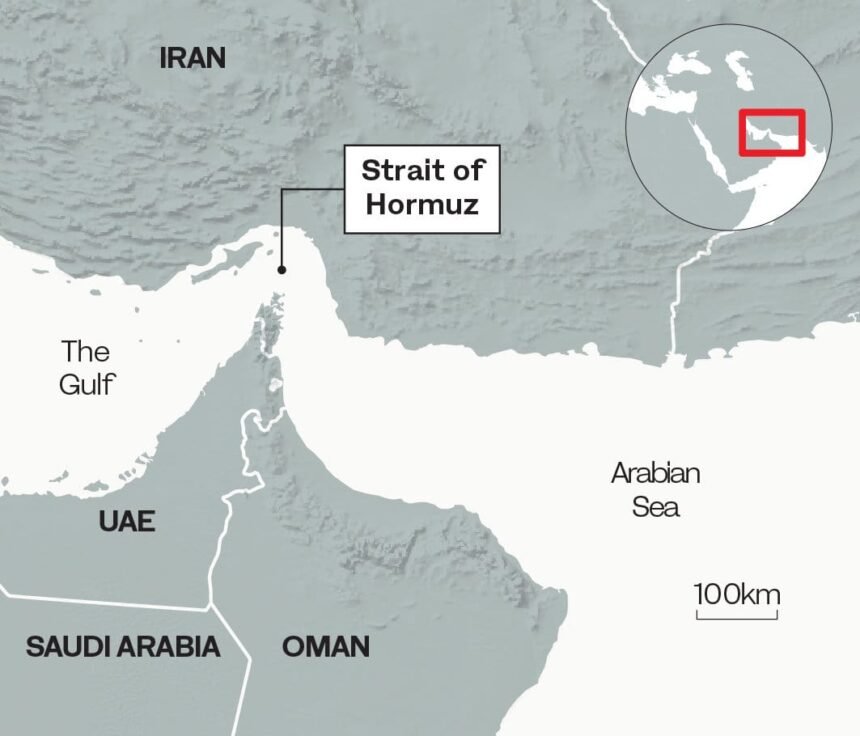
The strategic Strait of Hormuz, one of the world’s most important shipping lanes, has become the center of rising global tensions as military conflict in the Middle East continues to escalate. As of March 3, 2026, maritime activity in the region has slowed dramatically following Iran’s announcement that the vital waterway is effectively closed.
The Islamic Revolutionary Guard Corps (IRGC) declared on March 2 that the strait was “closed,” warning that any vessel attempting to pass through could be targeted. Although U.S. Central Command (CENTCOM) disputes this claim and insists the route remains legally open, commercial shipping traffic has nearly come to a standstill due to serious security concerns.
The Strait of Hormuz is a narrow but crucial passage connecting the Persian Gulf to international waters. Nearly one-fifth of the world’s oil supply moves through this route every day. Because of the growing threat, major global shipping companies, including Maersk and Hapag-Lloyd, have suspended their operations in the area. Insurance providers have also withdrawn war-risk coverage, making commercial transit extremely risky.
Energy markets reacted immediately. Oil and gas prices surged worldwide after reports of attacks on regional energy infrastructure. Qatar’s state-owned petroleum company halted liquefied natural gas production after two of its facilities were reportedly struck, further increasing fears of a global energy shortage.
The latest developments come after joint U.S. and Israeli military strikes on Iran, which reportedly resulted in the death of Iran’s Supreme Leader Ayatollah Ali Khamenei. Since then, tensions have intensified across the region, with missile exchanges continuing between Iran and Israel.
Israeli authorities reported intercepting missiles over major cities including West Jerusalem, Tel Aviv, and Eilat. At least ten deaths have been confirmed in Israel since the escalation began. Meanwhile, strikes in Iran and Lebanon have pushed the regional death toll beyond 600, according to various reports.
U.S. President Donald Trump stated that the military campaign against Iran could continue for approximately four weeks, emphasizing Washington’s goal of dismantling Iran’s missile systems and nuclear capabilities.
Iran has also targeted energy and military locations across Gulf states, widening fears of a broader regional war. Governments worldwide are closely monitoring the situation, as any prolonged disruption in the Strait of Hormuz could severely affect global trade, fuel prices, and economic stability.
While diplomatic efforts continue behind the scenes, uncertainty remains high. The disagreement over whether the strait is officially closed highlights the fragile balance between military claims and international law.
For now, shipping companies, energy markets, and governments are preparing for prolonged instability, as one of the world’s most critical maritime corridors faces its most serious crisis in decades.